Why Base hosts RWA liquidity
Base is quickly becoming the go-to layer-2 for real-world asset (RWA) tokenization. This isn't just about hype; it's about infrastructure that actually works for institutional players. RWAs are digital tokens representing physical assets like treasury bills, real estate, or private credit. For these assets to move on-chain, they need a network that is cheap, fast, and trusted. Base delivers on all three.
The fee structure on Base is a major draw. Tokenizing assets involves multiple transactions: minting, transferring, and settling. On Ethereum mainnet, these costs can eat into the thin margins of financial products. Base keeps gas fees negligible, making it economically viable to tokenize even small-value assets. This efficiency is critical for RWAs, where the value proposition often lies in fractional ownership and high-frequency settlement.
Coinbase's integration provides a unique advantage. As a bridge to the traditional financial world, Coinbase has millions of verified users. Base, built by the Coinbase engineering team, offers a seamless path for these users to interact with on-chain assets. This reduces the friction of onboarding. Institutions don't want to navigate complex wallets or worry about network congestion. Base offers a familiar, stable environment that feels like a natural extension of the Coinbase ecosystem.
Institutional readiness is another key factor. RWAs require compliance, security, and reliability. Base has focused heavily on building a robust developer ecosystem and partnering with established infrastructure providers. This creates a trustworthy layer for financial applications. The network's stability and uptime are essential for assets that represent real money. Base has proven its ability to handle significant traffic without compromising performance, a trait that financial institutions demand.
The growth trajectory of Total Value Locked (TVL) on Base reflects this institutional interest. As more RWAs migrate on-chain, the network's utility expands beyond speculative trading. It becomes a settlement layer for real economy assets. This shift is fundamental. It moves blockchain from a speculative playground to a functional financial infrastructure. Base is positioning itself at the center of this transition, offering the tools and stability needed for serious asset tokenization.
Key protocols driving RWA on Base
The infrastructure layer for Real-World Assets on Base is shifting from experimental pilots to established, high-volume rails. Rather than relying on a single monolithic platform, the ecosystem now features specialized protocols that handle specific asset classes, from tokenized treasuries to private credit. These platforms provide the legal wrappers, oracle feeds, and compliance gates necessary to bring traditional finance onto a high-throughput, low-cost L2.
Ondo Finance: Institutional Treasuries
Ondo Finance has positioned itself as the primary bridge for institutional-grade tokenized treasuries on Base. By issuing products like OUSG (tokenized US Treasuries) and USDY (a yield-bearing stablecoin), Ondo allows DeFi users to access regulated, low-risk yield without leaving the ecosystem. The protocol integrates directly with major Base DEXs, making it a foundational liquidity layer for risk-averse capital.
Centrifuge: Private Credit and Real Estate
Centrifuge operates the plumbing for non-traditional assets, focusing on real estate and private credit. On Base, it enables lenders to originate loans backed by real-world collateral, which are then tokenized and sold to DeFi liquidity providers. This model diversifies yield sources beyond crypto-native volatility, connecting Base liquidity directly to traditional credit markets through its rigorous due diligence framework.
Maple Finance: Institutional Capital Markets
Maple Finance brings institutional underwriting to Base by allowing corporate borrowers to raise capital directly from institutional treasuries. The protocol uses a staking model where capital providers select specific credit pools based on risk appetite. This creates a transparent, permissioned market for corporate debt, offering higher yields than traditional savings accounts while maintaining institutional-grade compliance and reporting.
Comparison of Top RWA Protocols on Base
| Protocol | Primary Asset Class | Yield Source | Target Investor |
|---|---|---|---|
| Ondo Finance | Tokenized Treasuries | US Govt Bonds | DeFi Yield Seekers |
| Centrifuge | Private Credit/Real Estate | Corporate Loans | Institutional Lenders |
| Maple Finance | Corporate Debt | Corporate Borrowing | Institutional Treasuries |
The convergence of these protocols creates a robust infrastructure where Base acts as the settlement layer. Users can swap between tokenized treasuries, private credit, and corporate debt seamlessly, leveraging Base’s speed and low fees to execute complex financial strategies that were previously too costly for retail participants.
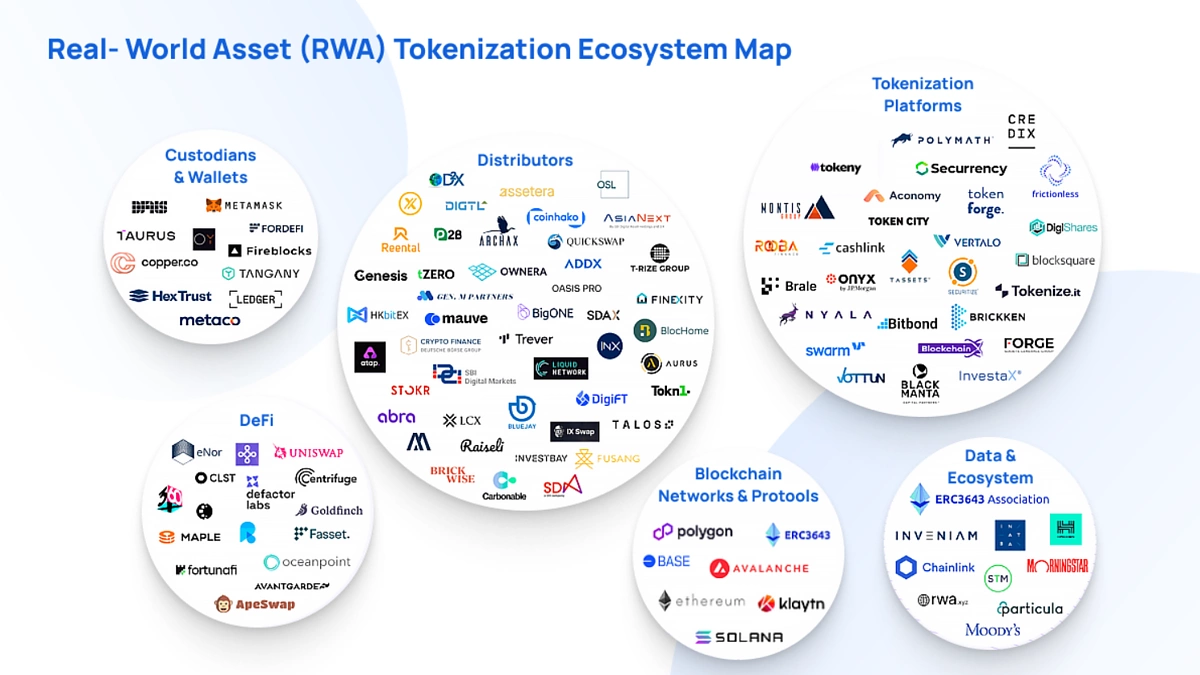
The Technical Stack Behind Tokenized Assets
Tokenizing real-world assets isn't just about minting a digital certificate; it requires a robust infrastructure layer to bridge physical value with on-chain liquidity. On Base, this stack relies on three interconnected components: price oracles for accurate valuation, secure custody solutions for asset backing, and compliance layers to meet regulatory standards. Without these pillars, tokenized assets remain speculative experiments rather than functional financial instruments.
Price Oracles: The Truth Layer
The most critical component is the oracle network. Since blockchain smart contracts cannot access external data on their own, oracles feed real-world price data into the chain. For RWAs, this is non-negotiable. If the price of a tokenized Treasury bill or real estate fund drifts from its actual market value, the entire system becomes vulnerable to arbitrage or liquidation cascades.
Chainlink serves as the standard for this verification. Their decentralized oracle networks provide tamper-proof data feeds that update in near real-time. This ensures that the on-chain representation of an asset matches its off-chain reality. Without a trusted oracle, a tokenized asset is just a number in a database, disconnected from the market it claims to represent.
Custody and Compliance: The Trust Layer
Beyond price, the asset itself must be securely held. Custody solutions provide the legal and technical framework for holding the underlying physical or financial asset. This involves traditional banking partnerships, legal wrappers, and often, multi-signature wallets to control the private keys.
Compliance layers sit on top of custody. They ensure that only verified investors can hold or trade these tokens. This involves integrating identity verification (KYC) and transaction monitoring directly into the smart contract logic. On Base, this means leveraging tools that allow developers to embed compliance rules without sacrificing the speed and low cost of the L2 network.
Putting It Together
The infrastructure for RWAs on Base is mature enough for serious deployment. By combining Chainlink's oracle reliability with institutional-grade custody and automated compliance, developers can create tokenized assets that are both liquid and secure. This stack transforms traditional assets into programmable financial primitives, opening up new markets for liquidity and access.
Market Trends and Yield Opportunities
The RWA sector has shifted from speculative novelty to a tangible liquidity layer, currently valued at approximately $66.4 billion. This growth is driven by the demand for sustainable yield in DeFi, where tokenized assets bridge the gap between traditional finance and decentralized protocols. As infrastructure matures, the focus is shifting toward transparent, on-chain settlement of real-world value.
A critical metric for investors is the yield spread between traditional fixed-income assets and their tokenized counterparts. Tokenized U.S. Treasuries, for example, offer yields that closely track the Federal Reserve’s benchmark rates, minus minimal on-chain friction costs. This efficiency allows DeFi users to capture risk-free rates without the delays of traditional banking settlement. The spread remains a primary driver for capital inflow into Base-based RWA hubs.
Looking ahead to 2026, projections suggest continued consolidation among infrastructure providers. The market is moving away from high-risk, unsecured lending protocols toward asset-backed, regulated instruments. This trend reduces systemic risk while maintaining the composability that defines DeFi. Investors are increasingly prioritizing protocols with clear regulatory compliance and transparent reserve audits.
Risks and compliance considerations
Real-world asset (RWA) DeFi hubs operate at the intersection of traditional finance and blockchain, which introduces a unique set of risks. Unlike pure crypto assets, RWAs are tethered to off-chain legal structures and physical realities. If those underlying structures fail, the on-chain token may become worthless, regardless of how secure the smart contract is.
Smart contract and oracle risks
The code governing RWA protocols is only as strong as its weakest link. Smart contract vulnerabilities can lead to exploits, but RWA-specific risks also include oracle failures. Oracles provide the price data and status updates needed to manage collateral. If an oracle feed is manipulated or delayed, the protocol may liquidate assets incorrectly or fail to enforce collateral requirements. This technical dependency means that even a perfectly written contract can fail if the data feeding it is compromised.
Regulatory uncertainty
The regulatory landscape for RWA DeFi is still evolving. Unlike Bitcoin or Ethereum, which have clearer (though still complex) classifications, RWAs often fall into gray areas involving securities laws, banking regulations, and cross-border compliance. Protocols must navigate varying jurisdictions, which can lead to sudden operational changes or shutdowns if regulators decide a specific tokenization model violates existing laws. This uncertainty creates a persistent risk for investors and operators alike.
Off-chain legal enforcement
Perhaps the most significant risk is the disconnect between on-chain tokens and off-chain legal rights. If the legal entity holding the underlying asset defaults or goes bankrupt, the token holder’s ability to claim the asset depends on the strength of the legal documentation. In many cases, the token is merely a claim against a custodian, not direct ownership of the asset. If that custodian fails, recovery can be slow and uncertain.
Due diligence checklist
Before engaging with any RWA protocol, consider these critical checks:
- Legal structure: Does the protocol have clear legal documentation linking the token to the underlying asset?
- Custodian risk: Who holds the off-chain assets, and are they audited?
- Oracle transparency: Is the oracle data source open and verifiable?
- Regulatory compliance: Does the protocol have a clear compliance strategy for key jurisdictions?
- Smart contract audits: Have the contracts been audited by reputable firms, and are the reports public?
No comments yet. Be the first to share your thoughts!