Why Base leads RWA tokenization
Real-world assets (RWA) represent a $10 trillion opportunity where tokenized financial instruments merge the utility of DeFi with the safety of traditional finance. However, not all blockchains are built to handle the specific demands of institutional-grade asset tokenization. Base has emerged as the dominant chain for this sector, not by accident, but through a deliberate alignment of cost structure, developer activity, and institutional readiness.
The primary driver is Base’s fee structure. For RWA tokenization, where transactions may involve high-value settlements but lower frequency, predictable and low gas costs are non-negotiable. Base offers significantly lower transaction fees compared to other leading Layer 2 solutions, reducing the friction for both issuers and investors. This cost efficiency is critical when dealing with assets like treasury bills or private credit, where margin compression is a constant concern.
Beyond economics, Base benefits from a robust developer ecosystem anchored by Coinbase. This integration provides a natural on-ramp for traditional finance institutions already familiar with Coinbase’s custodial and compliance infrastructure. The result is a network where regulatory clarity and technical scalability coexist, making it the preferred choice for projects aiming to bridge traditional capital with decentralized markets.
To understand the broader market context in which Base operates, it is helpful to look at the performance of the underlying Ethereum network, which serves as the settlement layer for most of these Layer 2 solutions.
Top RWA protocols on Base
Base has emerged as a primary infrastructure layer for real-world asset tokenization, hosting protocols that bridge traditional finance with on-chain liquidity. These platforms specialize in specific asset classes, ranging from U.S. Treasury bills to private credit and tokenized equity. Understanding the distinct focus of each hub helps investors and builders choose the right infrastructure for their risk profile and yield strategy.
The ecosystem is currently defined by three primary protocols that handle the bulk of RWA volume on the network. Each serves a different segment of the market, from institutional-grade treasury management to decentralized private lending.
Ondo Finance
Ondo Finance acts as the primary gateway for tokenized U.S. Treasuries on Base. The protocol issues products like USDY (US Dollar Yield) and OUSG, which represent direct exposure to short-term government debt. By tokenizing these assets, Ondo allows Base users to earn yield backed by the full faith and credit of the U.S. government without leaving the blockchain.
The protocol integrates directly with major custodians and issuers, ensuring that the on-chain tokens are fully backed by off-chain reserves. This structure appeals to institutional investors seeking stable, low-volatility yields within the DeFi ecosystem. Ondo’s presence on Base provides deep liquidity for these treasury products, making them accessible to a broader range of participants.
Centrifuge
Centrifuge focuses on real-world credit, specifically connecting small and medium-sized enterprises (SMEs) with DeFi liquidity. Instead of tokenizing treasuries, Centrifuge brings asset-backed loans onto the blockchain. These loans are collateralized by real-world assets such as invoices, real estate, or equipment, creating a diversified pool of credit risk for investors.
The protocol operates through a network of asset originators who vet borrowers and manage the underlying assets. Investors on Base can then provide liquidity to these pools, earning yield derived from the interest payments made by the borrowers. This model creates a direct link between traditional business financing and decentralized capital, offering yields that typically outperform risk-free treasury rates.
Goldfinch
Goldfinch is a permissionless credit protocol that enables uncollateralized lending in stablecoins. Unlike traditional DeFi lending that requires over-collateralization, Goldfinch uses a staking mechanism to absorb losses, allowing borrowers to access capital based on their creditworthiness rather than their crypto holdings. This approach opens up lending to businesses and individuals who may not have significant crypto assets to lock up.
On Base, Goldfinch provides a high-yield alternative for lenders willing to take on credit risk. The protocol’s governance model allows stakeholders to vote on which borrower pools to support, ensuring that capital is directed toward vetted opportunities. This decentralized approach to credit assessment reduces reliance on centralized intermediaries while maintaining a focus on real-world economic activity.
Comparison of Base RWA Protocols
The following table compares the primary RWA protocols on Base, highlighting their asset classes, typical yield ranges, and entry requirements.
| Protocol | Asset Class | Min. Entry | Risk Profile |
|---|---|---|---|
| Ondo Finance | U.S. Treasuries | $100 | Low |
| Centrifuge | Asset-Backed Credit | $100 | Medium |
| Goldfinch | Uncollateralized Credit | $100 | Medium-High |
The compliance stack: oracles, identity, and custody
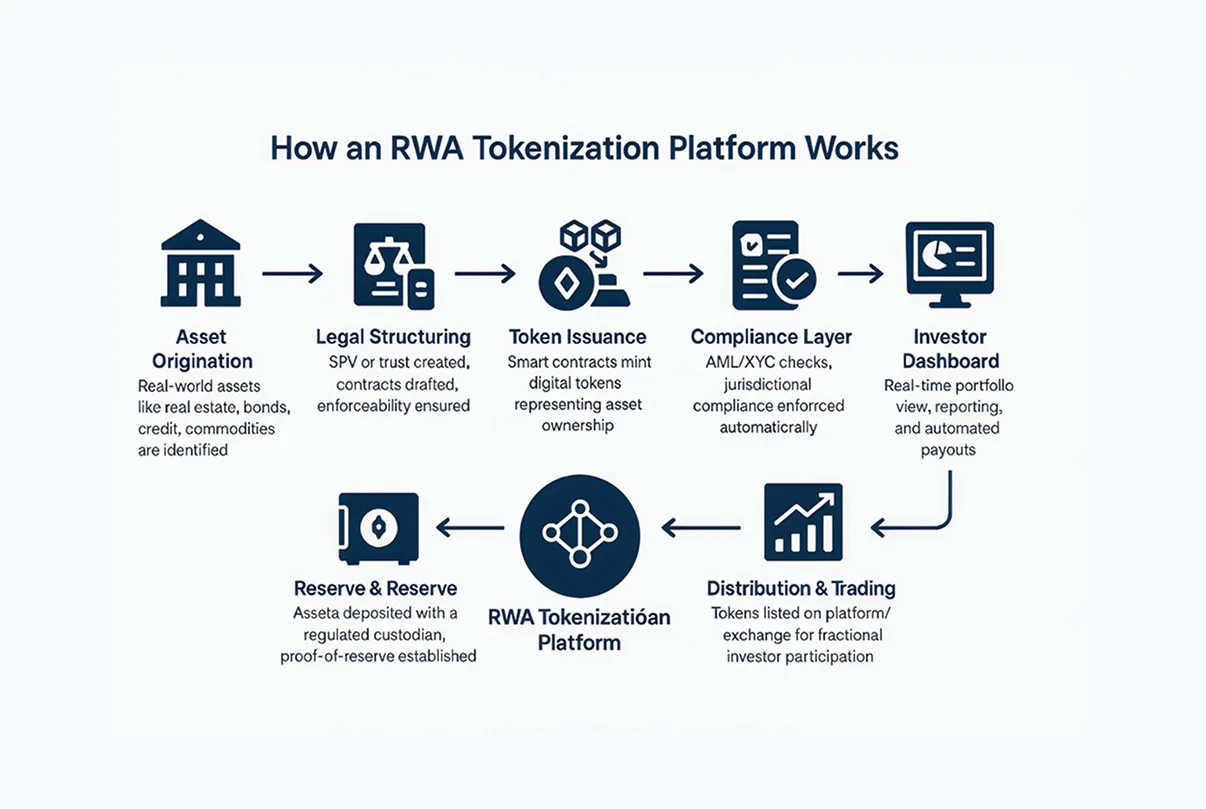
Real-world asset (RWA) hubs do not function as simple ledgers; they are engineered systems where physical reality meets digital enforcement. For high-stakes financial decisions, the viability of these hubs rests on a specific technical and regulatory stack. Without this infrastructure, tokenized assets remain speculative bets rather than reliable financial instruments.
The foundation is data integrity. Oracles bridge the gap between off-chain asset performance and on-chain smart contracts. They verify that the underlying asset—whether a Treasury bill or a piece of real estate—maintains its claimed value and status. If an oracle fails to report a default or a valuation shift accurately, the entire financial structure built on that asset collapses. This layer ensures that the digital token reflects the true state of the physical world.
Identity and custody form the regulatory backbone. Know Your Customer (KYC) and Anti-Money Laundering (AML) protocols are not optional add-ons; they are embedded into the token standard itself. Non-transferable identity tokens or soulbound tokens verify that only approved participants can hold or trade the asset. This compliance layer is managed by regulated custodians who hold the physical proof of ownership, ensuring that the digital claim is backed by legal enforceability.
The convergence of these layers creates a secure environment for institutional capital. Oracles provide the truth, identity tokens provide the permission, and custodians provide the legal recourse. Together, they transform illiquid, opaque assets into transparent, tradeable digital instruments.
How to evaluate RWA hub safety
Evaluating the safety of a Base RWA hub requires looking beyond the token price. You need to verify that the off-chain legal structures actually hold up and that the on-chain data is transparent enough to audit. Without this dual verification, you are betting on code that might not have legal backing.
| Feature | Safe Hub | Risky Hub |
|---|---|---|
| Legal Opinion | Published and verifiable | Vague or absent |
| Custodian | Tier-1 Bank or Regulated Entity | Unknown or Self-Custodied |
| Attestation | Monthly Third-Party Reports | None or Infrequent |
Base RWA market context
Understanding the broader market helps contextualize individual hub risks. The RWA sector is growing rapidly, but so are the complexities. Use live data to track the performance of leading RWA tokens and their underlying asset classes.
Note: The chart above illustrates general market volatility. Always correlate RWA hub performance with broader DeFi trends and regulatory news.
Common questions about Base RWA hubs
Investors often worry about the regulatory safety and liquidity of tokenized assets on Base. While the network offers speed and low fees, understanding the specific risks of Real-World Assets (RWAs) is essential before committing capital.
For context on market trends, you can monitor broader crypto asset performance via the chart below, though RWA-specific data is often siloed within individual protocol dashboards.
No comments yet. Be the first to share your thoughts!